How Amazon Pricing Algorithm Works
How Amazon Pricing Algorithm Works
Amazon prices change constantly.
Sometimes hourly.
Sometimes daily.
Sometimes within minutes.
If you've ever added an item to your cart and watched the price change later — you’ve seen the algorithm in action.
This guide explains:
- What Amazon’s pricing algorithm is
- How dynamic pricing works
- What factors influence price changes
- How the Buy Box affects pricing
- Why prices rise and fall unexpectedly
- How shoppers can use this knowledge strategically
- How to validate real discounts via HighDeals.net
Understanding pricing mechanics gives you power.
📚 Quick Navigation
- What Is Amazon’s Pricing Algorithm?
- Dynamic Pricing Explained
- Key Factors That Influence Prices
- Supply and Demand Signals
- Competitor Monitoring
- The Buy Box Algorithm
- Seller Repricing Bots
- Why Prices Change in Your Cart
- Psychological Pricing Strategies
- How to Use This Knowledge as a Buyer
- Advanced Buy Box Mechanics
- Buy Box Rotation & Price Volatility
- Algorithm Testing & Price Experiments
- Price Elasticity Modeling
- Personalization Myths vs Reality
- Machine Learning Behind the Algorithm
- Case Study: New Tech Product Launch
- Case Study: Seasonal Appliance
- Case Study: Viral Product Pricing
- How Sellers Exploit the Algorithm
- Lightning Deals vs Algorithmic Price Drops
- Predicting Price Movement Patterns
- Advanced Buyer Strategy Framework
- Long-Term Smart Buying Model
- The Future of Amazon Pricing
- Final Strategic Summary
What Is Amazon’s Pricing Algorithm?
Amazon uses dynamic pricing algorithms powered by:
- Machine learning
- Real-time demand analysis
- Inventory forecasting
- Competitor scraping
- Seller competition monitoring
The goal?
Maximize revenue while staying competitive.
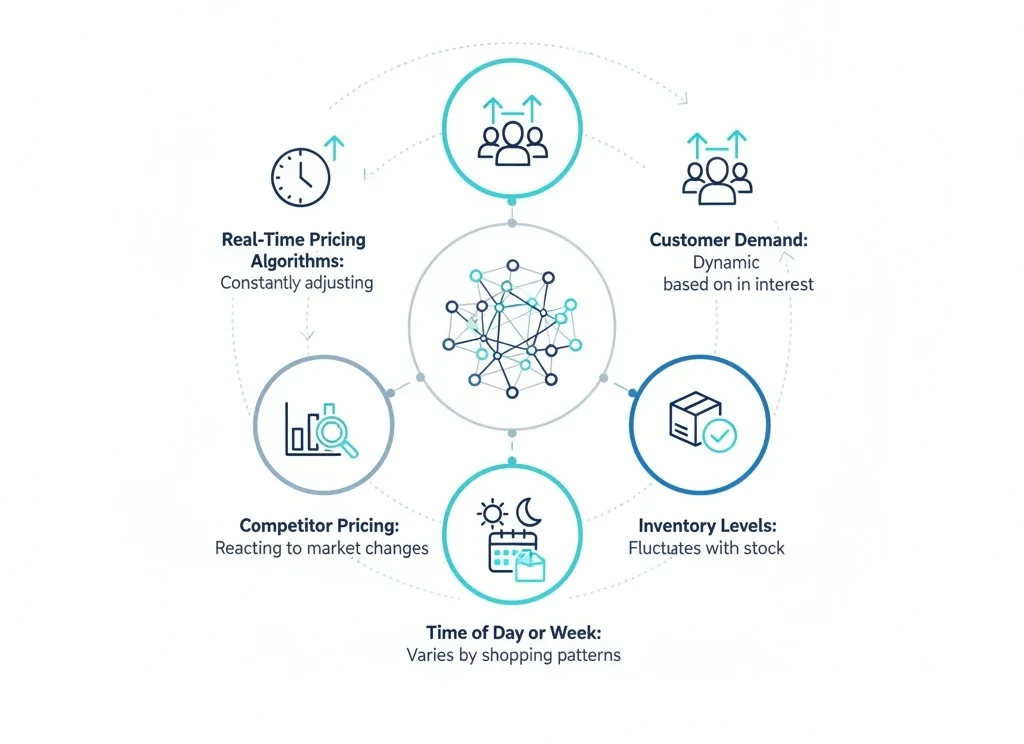
Amazon’s algorithm evaluates:
- Customer demand
- Product availability
- Competitor prices
- Seller performance
- Conversion probability
- Seasonal patterns
The system recalculates constantly.
Dynamic Pricing Explained
Dynamic pricing means:
Prices automatically adjust based on market conditions.
Airlines use it.
Hotels use it.
Uber uses it.
Amazon perfected it at scale.
Example Scenario
If 1,000 people search for a specific product within one hour:
- Demand spikes
- Conversion rate increases
- Algorithm may raise price slightly
If demand drops:
- Price may decrease to stimulate sales
Key Factors That Influence Prices
Let’s break down the major components.
1. Supply and Demand Signals
Amazon tracks:
- Search volume
- Click-through rate
- Add-to-cart rate
- Purchase conversion rate
- Time-on-page
If:
- Clicks ↑
- Conversions ↑
The algorithm detects high buying intent.
Price may increase gradually.
If:
- Views ↑
- Conversions ↓
Price may drop to stimulate purchasing.
Seasonal Demand Patterns
Examples:
- Heaters → price increases in winter
- Air conditioners → price increases in summer
- Fitness equipment → January surge
- Toys → November/December surge
Understanding seasonality helps buyers anticipate price movement.
2. Competitor Monitoring
Amazon constantly monitors:
- Walmart
- Target
- Best Buy
- Other marketplaces
If competitor price drops:
Amazon may match or undercut.
If Amazon detects competitor out of stock:
Price may increase.
External Price Scraping
Amazon's system compares:
- Online retailer pricing
- Third-party marketplace pricing
- Historical internal data
This ensures competitiveness while protecting margin.
3. Inventory Levels
Inventory plays a massive role.
If:
- Stock is high
- Demand is slow
Price may decrease.
If:
- Stock is low
- Demand is strong
Price often increases.
Example
If only 5 units remain and sales velocity is high:
Algorithm may increase price incrementally.
4. The Buy Box Algorithm
The Buy Box determines which seller appears as the default purchase option.
Multiple sellers can list the same product.
The Buy Box considers:
- Price
- Shipping speed
- Seller rating
- Fulfillment method
- Return rate
- Inventory availability
Winning the Buy Box dramatically increases sales.
How Pricing Affects the Buy Box
Sellers often:
- Lower price by cents to win Buy Box
- Use automated repricing tools
- Undercut competitors gradually
This creates micro price fluctuations throughout the day.
5. Seller Repricing Bots
Most professional sellers use repricing software.
These bots:
- Monitor competitor prices
- Adjust automatically
- Maintain profit margins
- Attempt Buy Box dominance
Result:
Price volatility increases when many sellers compete.
Example of Repricing War
Seller A: $29.99
Seller B: $29.98
Seller A bot: $29.97
Seller B bot: $29.96
And so on.
Eventually:
- Floor price is reached
- Margin protection triggers
Why Prices Change in Your Cart
Many buyers believe:
“Amazon raised the price because I viewed it.”
In reality:
- Pricing updates system-wide
- Your cart does not lock price (unless checkout completed)
- Algorithm refreshes periodically
If demand rises between viewing and checkout, price may increase.
Psychological Pricing Strategies
Amazon combines algorithmic pricing with psychological triggers.
1. Charm Pricing
$19.99 instead of $20.00
Improves perceived value.
2. Anchored MSRP
Shows:
“List Price: $199”
“Now: $149”
Even if historical price was $159.
This is why validation matters.
Check verified discount platforms like HighDeals.net to confirm true discount depth.
3. Lightning Deals
Limited-time deals:
- Increase urgency
- Boost conversion
- May temporarily override algorithmic pricing
But not all lightning deals are historical lows.
Machine Learning & Conversion Optimization
Amazon’s AI models evaluate:
- Likelihood of purchase at given price
- Elasticity of demand
- Cross-selling probability
- Customer lifetime value
If algorithm predicts:
Lowering price by 3% increases conversion by 10%
It may lower price.
If algorithm predicts:
Demand is inelastic
It may increase price.
Elastic vs Inelastic Products
Elastic:
- Generic accessories
- Commoditized products
Inelastic:
- Exclusive brands
- New tech releases
- Unique SKUs
Understanding elasticity helps buyers time purchases.
Algorithm and Prime Influence
Prime members convert at higher rates.
Products eligible for fast shipping may:
- Maintain slightly higher prices
- Experience stronger demand stability
Real Discount vs Algorithmic Illusion
Because pricing constantly changes, buyers must verify:
- Is current price near historical low?
- Is the discount artificially inflated?
- Is competitor price influencing movement?
That’s where platforms like HighDeals.net become valuable — they help filter strong verified discounts rather than reactive browsing.
How to Use This Knowledge as a Buyer
Now that you understand the mechanics, here’s how to act strategically:
- Monitor products over time
- Buy during demand dips
- Avoid launch windows
- Validate historical pricing
- Combine with stacking strategies
- Track seasonal cycles
Advanced Buy Box Mechanics
Winning the Buy Box is not simply about having the lowest price.
Amazon evaluates a weighted scoring model.
Key components include:
- Landed price (item + shipping)
- Fulfillment method (FBA vs FBM)
- Delivery speed
- Seller feedback score
- Order defect rate
- Return rate
- Inventory reliability
- Customer service performance
Each factor receives internal weighting.
Price is important — but not absolute.
Price vs Fulfillment Example
Seller A:
- Price: $99
- FBA
- 2-day delivery
Seller B:
- Price: $96
- FBM
- 7-day shipping
Seller A may still win the Buy Box.
Why?
Because conversion probability is higher.
Amazon prioritizes customer experience over lowest price.
Buy Box Rotation & Price Volatility
When multiple sellers meet quality thresholds, Amazon rotates the Buy Box.
This creates:
- Micro price shifts
- Frequent fluctuations
- Rapid repricing cycles
Each seller’s bot reacts to Buy Box wins and losses.
Result:
A pricing feedback loop.
Algorithm Testing & Price Experiments
Amazon constantly runs pricing experiments.
This includes:
- A/B price testing
- Conversion sensitivity testing
- Elasticity modeling
- Demand curve learning
A/B Price Testing
Amazon may show:
Group A → $47.99
Group B → $49.99
Then analyze:
- Conversion rate difference
- Revenue impact
- Cart abandonment rate
If revenue improves at $49.99:
That becomes new standard.
Price Elasticity Modeling
Amazon tracks:
- % change in price
- % change in demand
If a 5% price increase reduces demand by only 1%, revenue rises.
If a 5% increase reduces demand by 10%, revenue falls.
The algorithm constantly recalculates elasticity curves.
Personalization Myths vs Reality
Many shoppers believe:
“Amazon changes price based on my browsing history.”
There is no strong evidence of individual-level pricing.
Instead:
- Prices update globally
- Algorithm reacts to market behavior
- Variations are experiment-driven
Cart-based or device-based pricing manipulation is largely a myth.
Machine Learning Behind the Algorithm
Amazon uses large-scale ML systems that analyze:
- Billions of historical transactions
- Seasonality trends
- Inventory velocity
- Competitor response patterns
- Cross-product correlation
Models likely include:
- Regression models
- Reinforcement learning
- Time-series forecasting
- Demand prediction networks
The system evolves continuously.
Case Study 1: New Tech Product Launch
Phase 1: Launch
Price: High
Demand: Strong
Competition: Low
Phase 2: Competitors enter
Price: Drops
Buy Box wars begin
Phase 3: Market saturation
Price stabilizes
Margin compression
Best buyer strategy:
Wait for Phase 2 stabilization.
Case Study 2: Seasonal Appliance
Product: Space heater
September:
Demand low → lower prices
November:
Demand spike → price increase
January clearance:
Inventory flush → price drop
Strategic buyers purchase in September or January.
Case Study 3: Viral Social Media Product
When a product goes viral:
- Search spikes
- Conversions surge
- Inventory drains
- Price increases rapidly
After trend fades:
- Overstock risk
- Price drops below original
Watching trend lifecycle helps timing purchases.
How Sellers Exploit the Algorithm
Professional sellers understand algorithm signals.
They may:
- Temporarily lower price to increase sales velocity
- Build review count rapidly
- Then increase price after ranking improves
This creates artificial “discount cycles.”
Artificial Discount Pattern
Week 1:
Price: $24.99
Week 2:
Price: $19.99 (boost sales)
Week 4:
Price: $27.99 (anchor effect)
Displayed as: “Was $29.99”
Without historical tracking, buyers cannot detect this.
That’s why validation platforms like HighDeals.net help surface meaningful discounts rather than temporary manipulation.
Lightning Deals vs Algorithmic Price Drops
Lightning Deals:
- Time-restricted
- Promotional
- Often vendor-funded
Algorithmic Drops:
- Demand-responsive
- Competitive-driven
- Not labeled as “sale”
Sometimes algorithmic drops produce better value than promotional deals.
Predicting Price Movement Patterns
You can’t predict exact timing — but you can detect patterns.
Indicators of Possible Price Drop
- High inventory levels
- Low review growth
- Declining sales rank
- Seasonal transition
- Increased competition
Indicators of Possible Price Increase
- Inventory shortage
- Viral exposure
- Pre-holiday demand
- Competitor out-of-stock
- New product phase
Advanced Buyer Strategy Framework
Let’s formalize this.
Step 1: Identify Product Lifecycle Stage
- Launch?
- Growth?
- Maturity?
- Decline?
Lifecycle influences price stability.
Step 2: Check Seasonality
Is this peak demand season?
If yes — wait if possible.
Step 3: Monitor Competition Density
More sellers → higher repricing volatility → better chance of dips.
Step 4: Validate Historical Discount Depth
Use tools and curated deal platforms like HighDeals.net to:
- Identify real price drops
- Avoid artificial MSRP anchoring
- Spot genuine limited-time opportunities
Step 5: Stack Savings
Combine:
- Coupons
- Promotions
- Cashback
- Credit card rewards
- Deal validation
Algorithm timing + stacking = maximum savings.
Long-Term Smart Buying Model
Professional deal hunters follow three principles:
- Patience
- Pattern recognition
- Validation
They rarely buy immediately.
Instead they:
- Track 2–4 weeks
- Observe fluctuations
- Wait for demand dip
- Confirm discount authenticity
Why Prices Fluctuate Hourly
High-competition categories:
- Electronics
- Supplements
- Household consumables
May change dozens of times daily due to repricing bots.
Low-competition niche items:
- Price stable for weeks
Category volatility matters.
The Future of Amazon Pricing
We can expect:
- Deeper AI reinforcement learning
- Faster competitor scraping
- More automated vendor negotiations
- Tighter Buy Box thresholds
- Increased real-time elasticity modeling
Dynamic pricing will only become more sophisticated.
Final Strategic Summary
Amazon pricing is driven by:
- Demand intensity
- Inventory pressure
- Competition density
- Seller behavior
- Machine learning optimization
Prices are not random.
They are optimized.
The algorithm seeks equilibrium between:
Maximum revenue
Maximum conversion
Competitive positioning
Smart buyers leverage:
- Off-season timing
- Lifecycle awareness
- Competition monitoring
- Validation tools
- Strategic stacking
Platforms like HighDeals.net complement this by filtering noise and highlighting meaningful discounts aligned with real market movement.
Closing Thoughts
Understanding the algorithm removes emotional buying.
Instead of asking:
“Why did the price change?”
You ask:
“What signal changed?”
That shift alone improves buying outcomes dramatically.
Posts in this series
- Best Smart Home Gadgets Under $100 in 2025
- Apple AirPods 4 vs. Sony WF-1000XM6: Which Are Worth It?
- How to Stack Cashback and Coupons Like a Pro
- The Rise of AI-Powered Shopping Assistants in 2025
- How to Track Amazon Price Drops
- How to Stack Coupons on Amazon (Complete 2026 Savings Blueprint)
- 10 Amazon Shopping Hacks That Save Money
- How Amazon Pricing Algorithm Works
- How to Combine Gift Cards and Discounts on Amazon
- Beginner’s Guide to Shopping on Amazon