How to Combine Gift Cards and Discounts on Amazon
How to Combine Gift Cards and Discounts on Amazon
Most shoppers use gift cards incorrectly.
Most shoppers also misunderstand discount stacking.
When you combine them strategically, you unlock one of the most powerful savings systems available on Amazon.
This guide explains:
- How Amazon gift cards work
- When they can be stacked
- What can and cannot be combined
- How coupons interact with gift cards
- How promotions apply in checkout
- Common mistakes to avoid
- Advanced stacking strategies
- How to validate real discounts using HighDeals.net
If used correctly, gift cards can multiply savings — not just reduce the total.
📚 Quick Navigation
Foundations
Practical Application
- Step-by-Step: Combining Gift Cards with Discounts
- Coupons + Gift Cards
- Lightning Deals + Gift Cards
- Subscribe & Save + Gift Cards
Advanced Strategies
- Using Discounted Gift Cards
- Credit Card Rewards Stacking
- Timing Purchases Strategically
- Avoiding Fake Discounts
Expert-Level Optimization
How Amazon Gift Cards Work
Amazon gift cards act as account credit.
Once redeemed:
- They sit in your Amazon balance
- They automatically apply at checkout
- They are used before your credit card
Gift cards:
- Do not expire (in most regions)
- Cannot be reloaded into cash
- Apply after promotional discounts
Types of Amazon Discounts
Understanding stacking requires knowing discount layers.
1. On-Page Coupons
Displayed as:
“Save $10 with coupon”
Applied at checkout.
Stackable with gift cards.
2. Lightning Deals
Time-limited promotions.
Gift cards can be applied normally.
3. Promotional Codes
Entered manually or auto-applied.
May have restrictions.
4. Subscribe & Save Discounts
Typically 5–15% off.
Applies before gift cards.
5. Credit Card Promotions
Example:
“5% back with Amazon Visa”
Applies after transaction, not before.
Stacking Rules Overview
Here’s the simplified stacking order:
- Product price
- On-page coupon
- Promotional code
- Lightning Deal adjustment
- Subscribe & Save discount
- Gift card balance
- Credit card rewards
Gift cards do not interfere with other discounts.
They reduce the payable amount at the final stage.
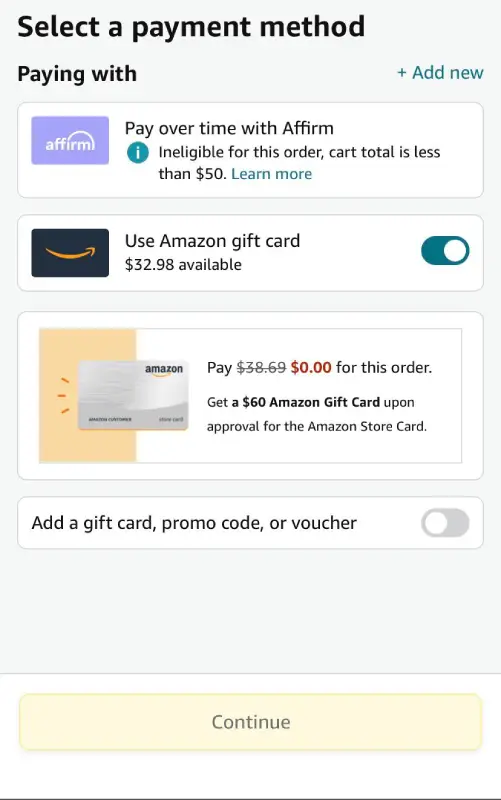
Step-by-Step: Combining Gift Cards with Discounts
Let’s walk through a realistic example.
Example Scenario
Product price: $200
Lightning Deal: -$40
Coupon: -$20
Subscribe & Save: -5% ($7)
New subtotal: $133
Gift card balance applied: -$100
Remaining balance: $33
Credit card cashback: 5% of $33
Total effective savings: significantly amplified.
Coupons + Gift Cards
Coupons apply before gift cards.
Meaning:
If product is $100
Coupon is $20
Gift card is $80
You pay $0 out of pocket.
This is legal and allowed.
Lightning Deals + Gift Cards
Lightning Deals already reflect discounted price.
Gift cards can apply normally.
However:
Lightning Deals often increase demand, so validate whether it’s a real historical low.
Use HighDeals.net to confirm discount depth.
Subscribe & Save + Gift Cards
Subscribe & Save discounts apply automatically.
Gift cards cover the remaining balance.
Advanced trick:
- Use gift card for first order
- Cancel subscription after shipment if needed
Using Discounted Gift Cards
This is advanced stacking.
Sometimes:
You can purchase Amazon gift cards at a discount (via promotions or cashback portals).
Example:
Buy $100 gift card for $95 equivalent.
Now every $100 purchase automatically starts with 5% savings.
Stack that with coupons.
Savings compound.
Credit Card Rewards Stacking
If your remaining balance after gift cards is small:
You may lose potential cashback.
Advanced strategy:
- Leave small balance on purpose
- Use reward credit card
- Earn cashback on remainder
Timing Purchases Strategically
Combine:
- Seasonal lows
- Major sales events
- Discounted gift card availability
- Coupon stacking windows
Strategic timing multiplies effect.
Avoiding Fake Discounts
Sometimes sellers inflate MSRP.
Gift cards make inflated discounts feel bigger.
Always validate:
- Historical price trends
- Seasonal average pricing
- Competitor price
Platforms like HighDeals.net help identify authentic discounts rather than artificially anchored pricing.
Real-World Stacking Scenarios
Scenario 1: Electronics Purchase
Black Friday
Lightning Deal
Coupon
Gift Card
Cashback card
Total savings: 25–40%
Scenario 2: Household Supplies
Subscribe & Save
Coupon
Gift Card
Recurring savings model.
Scenario 3: Viral Product Dip
Algorithmic price drop
Limited coupon
Gift card
Impulse prevented by validation.
Common Mistakes to Avoid
- Using gift card before verifying real discount
- Missing coupon checkbox
- Forgetting Subscribe & Save stacking
- Ignoring cashback layering
- Paying full with gift card when cashback promo exists
Long-Term Savings Framework
Professional savers:
- Accumulate discounted gift cards
- Monitor price cycles
- Validate deals externally
- Stack methodically
- Avoid emotional purchases
Gift cards become a strategic reserve, not impulse fuel.
Final Strategic Summary
Combining gift cards and discounts works because:
- Gift cards apply after discounts
- They do not cancel most coupons
- They stack with Lightning Deals
- They compound with cashback
- They amplify validated discounts
But validation is essential.
Before using your balance:
Check historical discount strength via trusted deal aggregators like HighDeals.net.
The goal isn’t spending gift cards.
The goal is multiplying their value.
Closing Thoughts
Gift cards are not just payment methods.
They are leverage.
Used strategically, they:
- Lower effective cost
- Increase stacking flexibility
- Enhance seasonal savings
- Improve buying timing
Used impulsively, they:
- Encourage rushed purchases
- Hide inflated pricing
- Reduce cashback potential
The difference is strategy.
And now you have it.
Posts in this series
- Best Smart Home Gadgets Under $100 in 2025
- Apple AirPods 4 vs. Sony WF-1000XM6: Which Are Worth It?
- How to Stack Cashback and Coupons Like a Pro
- The Rise of AI-Powered Shopping Assistants in 2025
- How to Track Amazon Price Drops
- How to Stack Coupons on Amazon (Complete 2026 Savings Blueprint)
- 10 Amazon Shopping Hacks That Save Money
- How Amazon Pricing Algorithm Works
- How to Combine Gift Cards and Discounts on Amazon
- Beginner’s Guide to Shopping on Amazon